

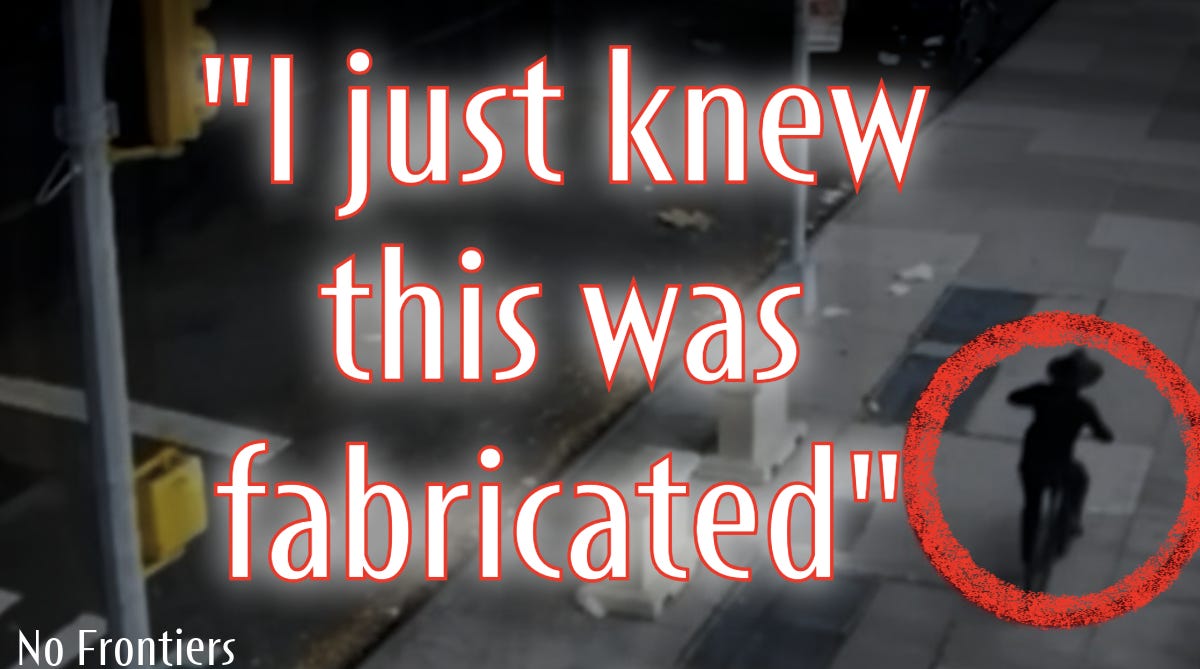
"I just knew this was fabricated"
Q&A with Jenin Younes, Palestinian-American first amendment lawyer, on the bizarre phenomenon of antisemitic hoaxes.

In Nice, France, an unidentified man wearing a Jewish kippah confronted a pro-Palestinian protest in early March, reportedly telling them to ‘go back to Gaza’. As he argued and walked away, he screamed, took off his kippah, and feigned being attacked by the group, running toward a police officer a few meters away.
In December 2019, a Jewish man named Sean Sammit said he was attacked and stabbed by an assailant yelling antisemitic insults in his Michigan synagogue. Police soon found Sammit had faked the incident, stabbed himself, and reported it to authorities as a hate crime.
And the list goes on.
These hoax antisemitic incidents aren’t outliers. They are increasingly common incidents, especially as pro-Palestinian solidarity has grown worldwide during the Zionist regime’s post-Oct. 7 genocide.
Across the West, vigilante antisemitic hoaxes perpetrated by Zionist Jews have become commonplace, especially during the global rise in Palestinian solidarity after Oct. 7. These actions are aimed at stoking widespread racist fear and hatred of imaginary Arab and Muslim “extremism,” and galvanizing support for white Jewish supremacy, the Zionist settler colony of Israel, and the genocidal massacre of Palestinians.
In a recently published news and social media analysis, No Frontiers found scores of hoax antisemitic incidents from the last decade. Between 2016 and 2026, there were 65 antisemitic hoax incidents across 14 countries.
No Frontiers spoke with lawyer Jenin Younes, national legal director and now-interim president for the Arab-American Anti-Discrimination Committee (ADC), who regularly encounters the rising phenomenon of antisemitic hoaxes by Zionist provocateurs.
At the ADC, Younes and her colleagues are on the front lines fighting Islamophobic discrimination, attacks on the free speech of the pro-Palestine movement, and the Israel lobby’s efforts to globally enshrine the International Holocaust Remembrance Alliance (IHRA), a law banning criticism of Israel and criminalizing pro-Palestine solidarity.
Younes spoke on what she makes of these antisemitic hoaxes, most of which are perpetrated by Zionist Jews, and how widespread anti-semitism actually is in the West. Younes also represents an elderly pro-Palestine activist who is being sued by a member of Betar USA, a Jewish supremacist terror group that operated in New York and Washington, DC.
This interview has been lightly edited and condensed for clarity.

Read the No Frontiers investigation into hoax antisemitic incidents here.
The rise of antisemitic hoaxes
No Frontiers:
Well, thank you so much for joining me. I really appreciate it. Would you mind introducing yourself and saying a bit about the kind of work that you do?
Jenin Younes:
My name is Jenin Younes. I’m the national legal director for the American-Arab Anti-Discrimination Committee. I currently do a lot of First Amendment cases around suppression of pro-Palestine speech. In the past, I actually did a lot of work around civil rights issues related to COVID and censorship around COVID. I don’t want to say my political affiliations; I’ve always been kind of an independent, but I’m working with very different people than I worked with five years ago, let’s say.
NF:
I got interested in your perspective on these kinds of fake antisemitism incidents when a man in Orthodox Jewish appearance was caught on camera painting two swastikas on a Jewish school in Brooklyn just hours after Zohran Mamdani was elected mayor. And I saw that you had commented on that and mentioned that this is an ongoing phenomenon of people who are found out to be Jewish Zionists who are often the ones faking these incidents.
Can you explain how you’ve come across this phenomenon over the years and what you make of it?
Younes:
Yeah, sure. I have a lot to say on the subject. So just to preface that: Of course, there’s anti-semitism in the world, and there are antisemitic hate crimes, for sure. I would never say otherwise. I want to be very clear about that. And I think I deleted one of the tweets I wrote on [Zionist antisemitic hoaxes] because I inartfully used the term Jewish instead of Zionist. I should have said Zionist, which is what I meant.
I would say that, broadly speaking, there is a general attempt by many people high up in, sort of, Zionist positions, like the Anti-Defamation League, the government of Israel, a lot of people in our government, to make it seem as though anti-semitism is a scourge in the United States and in the West that needs extreme measures to be eradicated. And I think part of that is to tamp down on criticism of Israel.
It’s a sleight of hand that’s used to say “there’s this huge, huge problem of anti-semitism and so, therefore, we need to take extreme measures such as banning people who don’t like Israel [, or] banning people who say things that offend some Jewish people,” and that kind of thing.
And so what this does is conflate notions of anti-semitism and anti-Zionism or anti-Israel sentiment. So that’s not like what we’re talking about, exactly, in terms of Zionists faking hate crimes, but it’s important to understand the context in which this takes place, that this really is a mass attempt to make it seem as though Jews are simply not safe in the West, and that sort of justifies Israel in its existence and everything that it does, and also justifies suppressing speech critical of Israel by conflating these notions.
And so against that backdrop, there have been a lot of incidents where it turned out that once the perpetrator of a hate crime was found, it turned out that the person was a Jewish Zionist, not a Christian Zionist, a Jewish Zionist. And that is, again, part of this broad attempt to justify Israel in everything it does and garner support for Israel.
NF:
I was introduced to this notion or phenomenon of Zionists faking these hate crimes because there were so many incidents during the campus pro-Palestine encampments, especially in New York City. You saw a lot of Zionist students, then you had like Betar [USA] come out, which I think you have a case with Betar.
Younes:
I do, yeah.
NF:
I think you’re probably very, very familiar with them.
Younes:
I am, yeah.
Some of the time, it’s turned out that swastika or anti-semitic graffiti turned out to be, you know, they got a camera, and it turned out the person was a Zionist, not an anti-Zionist, or not an Arab, or something like that.
I look at a lot of these incidents as part of my work because what I’m often doing is saying that speech suppression is actually not about stopping anti-semitism or speech attempts to suppress speech; censorship measures are not about stopping anti-semitism, but about tamping down on criticism of Israel or suppressing criticism of Israel.
So I’ve looked closely at the statistics and at what the claims are around this. And there’s a lot of conflation of anti-Semitism and anti-Zionism.
The ADL reports these horrendous statistics in California schools. But then, when you look at what counts as an anti-semitic incident, and I’m not making this up, there’s one of a student wearing a Palestine flag on their t-shirt, [and of] a movie about the occupation in the West Bank being shown in class. These are reported as antisemitic incidents.
And so I think that makes people get a skewed sense of just how anti-semitic the United States and the West really are.
I was a young person in New York. I’m not young anymore, but I lived in New York from when I was about twenty-four to thirty-seven, and I went to NYU Law School. And this idea that campuses are infiltrated with anti-semites is so contrary to my experience. Like, sure, there’s a fair amount of criticism of Israel on most college campuses in the United States, which is to be expected because young people care about social justice and equality and not having apartheid and all the things that Israel does. But I never saw any real antisemitism in my life.
And I’m not saying, of course, that nothing happens, but the idea that these are hotbeds of anti-semitism, where Jewish students aren’t safe, and they’re being turned away just because they’re Jewish, was just so contrary to the experience that I knew it couldn’t be true.
And then, indeed, when you look closely at the allegations, it’s really students saying Zionists aren’t allowed in here, not ‘Jews aren’t allowed here.’ Now what the Zionists say is, “Oh, it’s just a substitution. They mean Jewish. They’re just using it as code.” But most of the time they’re not. And, you know, frankly, half the kids are often Jewish in the pro-Palestine movement.
I was in Students for Justice in Palestine when I was in college, and like half the people were Jewish, at least. So that was another reason I just knew this was fabricated. My experience with the pro-Palestine movement has been that it’s always been full of Jewish people who are anti-Zionist.
NF:
As someone who is very familiar with the statistics and constantly looking at these incidents—I mean, antisemitism, of course, is an existing problem, but it doesn’t seem like antisemitism is the systemic problem that, say, policing is for black and brown people, for example. Would you say that’s fair?
Younes:
Yeah, absolutely. I would say there’s basically no anti-semitism coming from the government, which is probably the most important thing, right? But you see tons and tons of Islamophobia from high-up government officials, you know, calling for deporting all Muslims and Arabs and Palestinians and saying “They’re not welcome here. They shouldn’t be here. They can’t assimilate.”
You don’t see any politicians saying that about Jews, as you know, should be the case.
Of course, there is a strain of anti-semitism; I’d say it comes from the right, not the left, like the Elise Stefaniks of the world are always claiming. But I think it’s ironically getting worse because of Israel’s actions and our government’s support for it.
A lot of these people [are] on the right. I don’t know how much you’re on Twitter, but, like Dan Bilzerian and Jake Shields, I would say, are. They seem to care about Palestinian human rights, but I would say they are also anti-semitic—like actual anti-semites, they would identify as. I’m sure most people would identify them as on the right.
And they keep on saying that “the Jews control our government.” “The Jews,” you know, and then you see that our government is going to war basically for Israel. It’s like, “Well, you’re not helping.”
Again, of course, the average Jewish person should not be blamed for anything Israel does or anything the US government does or anything like that. That is anti-Semitism. But it does feed into their [Zionist] narrative.
NF:
Can you describe the case you’re working on to defend a person, a protester, against a Betar USA member?
Younes:
We’re representing the defendant, Janine Ali, and she was at a protest in front of the Dirksen Senate building. It was actually not really a protest. It was a vigil for children who’d been killed in Gaza, and she was with a group called CodePink that was actually founded by a Jewish anti-Zionist woman named Medea Benjamin.
They were carrying pictures of children who’d been killed in Gaza, and there was a counter-protest or a counter-demonstration by pro-Israel people, basically to keep the war going or whatever.
I don’t like to call it a war because it really wasn’t. It was a massacre, a two-year massacre.
So in any event, the woman [Kimmara Sumrall] who was heading the Betar chapter in DC—I don’t think she does anymore—alleged that our client, Janine Ali, pulled on her Israeli flag cape and choked her briefly from behind. She admitted she couldn’t see her. The evidence wasn’t very good. And Janine was actually acquitted at a criminal trial.
But then the woman, Kimmara Sumrall, slapped her with a civil lawsuit. She has some fancy Betar lawyers. The judge shockingly found that she was guilty of violating a section of Civil Rights Act of 1981, which I think his decision was totally wrong-headed. It’s sort of boring legalese stuff I don’t think most people are interested in, but generally speaking, the statute should be used only when there’s a state actor and they’re found to have engaged in racial discrimination.
But the judge found that pulling on the Israeli flag cape was essentially an act of racial discrimination.
And we were like, “Even if she did it, which she didn’t, that’s not racial discrimination.” Our client was clearly protesting Israel’s actions, not Jews. This wasn’t a hate crime against Jews. We have asked him to reconsider his decision, and we are awaiting his opinion on that. He hasn’t ruled on it. That’s our case that involves Betar.
NF:
Maybe it was a dispute between two people, but this wasn’t a hate crime. Maybe it’s not an antisemitic hoax, persé, but it is something that’s trying to undermine the Palestinian movement.
Younes:
Yeah. It’s part of a broader attempt to dissuade people from participating in pro-Palestine protests or anti-Israel protests and activity. Janine Ali is having to incur a lot of money in legal fees. We’re pro bono, but she has other lawyers, too.
So most people don’t want to risk it. They’re like, “You know what, I’ll just stay away from this. I don’t want to risk earning the ire of these crazy people,” these people who espouse violence to achieve their nationalist aims for Israel.
This is part of a larger movement to try to use anything—I would call it lawfare. They’ll try to seize on these incidents and twist them in order to fit under some kind of civil rights law provision or something like that. And frankly, a lot of judges are just kind of naive, and they buy it, and I think they’re predisposed to take the side of pro-Israel people.
A lot of judges fit in the age range, like I would say the maybe sixty to eighty age range, that really grew up with Jews being oppressed. You know, their memory of the Holocaust is very, very fresh, and Israel was not quite as crazy. Although I would say Israel’s founding involved a lot of violence in the ethnic cleansing of Palestinians and the murder of Palestinians. But, you know, it wasn’t quite as insane. So they grew up with a very different image than people of my generation and younger. I think they’re sort of predisposed to accept that these allegations of anti-semitism are true, and frankly, they are flat-out lies.
Sometimes I think they make things up. Other times, I think there’s a hysteria around it where people think they heard something. For instance, there’s a law student somewhere in California. I think it’s Oakland. Uh, and the plaintiffs are Jewish parents and are alleging that their children weren’t adequately protected against anti-semitism, and they give some examples. A lot of it was like a pro-Palestine video was shown, or a student was allowed to wear a pro-Palestine t-shirt or something. But then they claim that there was a walkout for Palestine, and students were exclaiming, “fuck the Jews.”
I’ve been to Oakland. My brother lives there. I find it really, really hard to believe that school children in Oakland are saying, “fuck the Jews.”
I think maybe some people are so scared. They live in so much fear. They’re so convinced the whole world hates them because they’re Jewish that they hear things that aren’t actually being said. And then sometimes I think they are lies.
NF:
Is there anything else you would like to add, as someone who is obviously in the trenches and who’s watching for these incidents all the time? Is there anything else that you think that people should know?
Younes:
I do want to briefly address the, uh, I don’t know when you’re going to use this. The March eleventh, March twelfth, incident in Detroit, where someone was stopped before he was planning to shoot up a synagogue. It’s kind of unclear, but it looks like he drove his car into a synagogue and was stopped before anybody else was injured, but he was killed. And so this is being portrayed as an antisemitic hate crime, which it obviously has elements of that. I’m not denying that, but it turns out the guy’s entire family was killed in Lebanon by an Israeli bomb last week.
Again, this isn’t exactly in the hoax category, but it’s part of this pattern of “See, there’s all this anti-semitism. We’ve got to let Israel kill more Arabs.”
Of course, I’m not excusing his violence. Everybody’s responsible for their own behavior. No matter what happened to his family, he should not be visiting that on innocent people. Of course. Absolutely. But this is something that’s going to happen when you have massive numbers of mass slaughters going on in other parts of the world, and people have family here.
This is also part of the pattern. And I think, unfortunately, there are a lot of bad actors who use these incidents to say, “See, this is an example that these Middle Easterners are savages, and we need to kill more of them in the Middle East,” stoking up Islamophobia and contributing to this vicious cycle of violence. So the exact opposite of what we should be doing.
NF:
Yeah, it’s seizing upon a real-life event and transforming it into something else. The biggest example I can think of, at least recently, is October seventh and all of the lies and actual hoaxes that came out of that, with the claims of mass rapes, and then the beheaded babies that are still being echoed today by Biden, by the Trump administration.
I think that was one of the alleged reasons Trump decided to attack Iran, which could be among a lot of different reasons, but that was one that Trump gave.
Can you describe how you are seeing this at the individual level? There are people—you said this in the very beginning—who are very high up in governmental leadership who are perpetuating these hoaxes or lies.
Younes:
That’s what makes it so scary: people who are in positions of great power who are doing it. Some of the worst offenders are Tom Cotton, Ted Cruz, John Fetterman on the Democratic side, you mentioned the president, Laura Loomer, who’s just completely nuts and not an elected official, but has the president’s ear. He apparently takes advice from her, which is crazy. It’s really scary.
You just don’t see people with this kind of power saying things about Jews. There are people saying horrible things about Jews on the internet, but they’re mostly guys sitting in their basements, not people with real political power at all.**
Lebanese journalist killed by Israel received death threats from now-unmasked Israeli journalist

Lebanon—At 2:45 (14:45) on Wednesday, the Al-Akhbar correspondent Amal Khalil and photojournalist Zeinab Faraj were driving en route to an Israeli bomb site near t…