

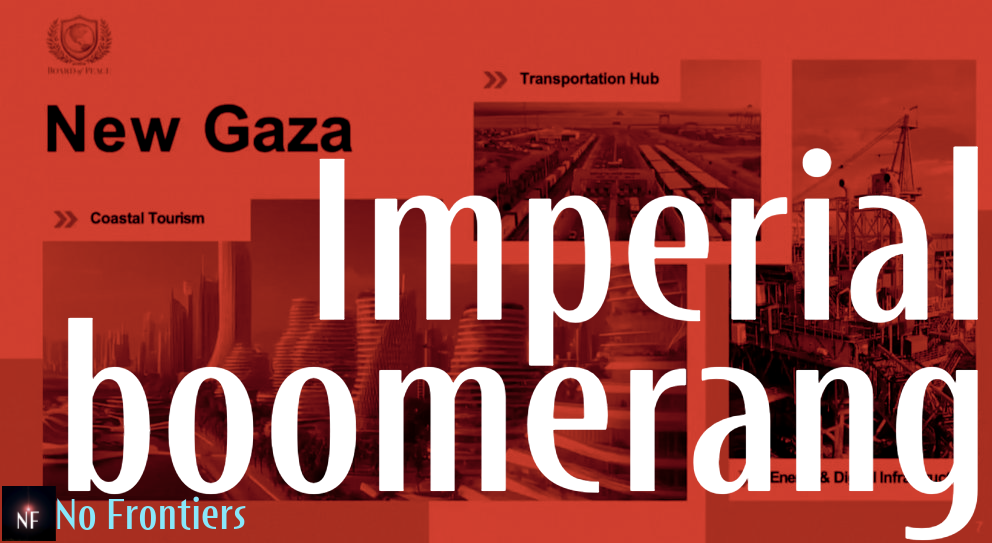
Trump's "imperial boomerang"
Q&A: Policy analyst Abdaljawad Omar on the Trump "imperial boomerang" effect on Gaza and US, and more

In February 2025,
I sent an email requesting an interview, along with a list of questions, to Abdaljawad Omar, a widely sought professor and policy analyst based in Ramallah, Gaza Strip, Palestine. As a professor and analyst, Omar’s scholarship and writing focus on Palestinian resistance, settler-colonialism, and revolutionary politics.
At the time, I was still trying to gain a foothold in understanding Palestinian history and gathering sources. The interview was going to be part of my recent pivot to reporting on Israel’s genocide of Palestinians, but I never incorporated it into any stories.
Now, finally, I’m releasing the interview. And it doesn’t disappoint.
One year later, Omar’s answers turned out to be almost a prophetic analysis of US President Donald Trump’s neo-Monroe Doctrine venture, his erratic and colonial foreign policies, and the next looming catastrophe that is the “Gaza Riviera.”
The United Nations estimates that the reconstruction of Gaza will cost about $70 billion, which could be quite a lucrative windfall for companies, but with a Trump-Kushner-Netanyahu dark triad leading the helm.
Here, Omar observes a Trump “boomerang” effect. This renowned “imperial boomerang” theory was first posited in 1950 by Aimé Césaire, an Afro-Martinique French poet, author, and politician, who argued that the brutal techniques and strategies used by colonial powers to control foreign territories are eventually deployed against their own citizens at home.
(In the original French, Césaire called it “un formidable choc en retour,” which doesn’t mean ‘boomerang,’ but something more like “a formidable shock in return.” In an earlier English translation, it was called a “terrific reverse shock”)
As one contemporary scholar has argued, “the work of Aimé Césaire and Frantz Fanon helps us better understand how colonialism creates the affective and psychological conditions for fascism.”
Colonialism begets fascism. Always has. After the Biden and then Trump administrations fully supported over two years of Israel’s unrestricted and unpunished genocidal rampage on Palestinians, some form of these colonial strategies was about to come home.
This interview is reproduced in full, with only minor edits for clarity.
No Frontiers: What do you make of Trump’s desire to colonize Gaza as well as other sovereign lands?
Abdaljawad Omar: One of the more striking features of the current geopolitical landscape is the contradictory nature of U.S. foreign policy under Trump. His rhetoric reflects a fusion of nationalist populism and transactional diplomacy, exacerbating tensions between competing strategic imperatives. On the one hand, the United States increasingly resembles a revisionist power—redefining its global posture through a modernized Monroe Doctrine, favoring ad hoc deals over institutional commitments, and demonstrating a willingness to pressure both allies and adversaries. This shift is evident in Washington’s erratic overtures toward Ukraine and Greenland, as well as its open disdain for traditional partners like Canada.
However, the real significance of this moment extends beyond the dangers of populism or the resurgence of a 19th-century colonial mindset repackaged in the language of 21st-century business deals. While these moves project disruption, strength, and a willingness to unravel established rules—both explicit and implicit—they also accelerate a broader shift away from American primacy. U.S. hegemony was not merely sustained through raw power but also through policies that provided incentives for allies and, at least superficially, upheld the principle of sovereignty. By undermining these mechanisms, the United States risks not only alienating key partners but also hastening the erosion of the very global order that once cemented its dominance.
Like Trump, Israel is also engaging in and advancing a form of revisionism—not only in its assertion of unrestrained power but also in its reliance on ethnic cleansing and genocide as colonial solutions to its inability to legitimize itself or extinguish the struggle over Palestine. Trump’s rhetoric is useful in this sense; it sets the real agenda that Israel seeks and desires, an agenda where war crimes and crimes against humanity become a practical solution celebrated on the pages of think-tanks and mainstream media.
NF: Trump’s desire to “own” Gaza and build a “Riviera”, where did this come from? Do you feel Trump, along with other private interests, was looking to get a slice of Gaza (and the West Bank) through Israel’s assault on Palestinians in Gaza after Oct. 7? Were parties in the US and Israel imagining carving up the Gaza Strip?
Abdaljawad Omar: Trump appears to be viewing Israel’s policies through the lens of a business deal—one that Netanyahu has strategically framed to secure American buy-in for ethnic cleansing. By presenting this as a transactional arrangement, Netanyahu has leveraged Trump’s instincts for deal-making to normalize policies of settler-colonial expansion and demographic engineering. In many ways, Trump is being manipulated into aligning with messianic fascist movements that seek to capture political attention and reshape the discourse around U.S. support for Israel.
Beyond this political alignment, there is also a clear element of economic opportunism at play. Gaza, in this framework, is being transformed into a commodified space—one whose destruction and potential reconstruction can serve both Trump’s economic interests and Israel’s long-term strategic goals. What is being sold is not merely a policy of ethnic cleansing but a vision in which Palestinian dispossession is repackaged as an opportunity for profit and geopolitical consolidation in the months and years to come.
NF: What do you make of Trump’s executive order to build America’s own “Iron Dome”? What is he trying to accomplish with this military move to emulate Israel’s Iron Dome?
Abdaljawad Omar: The concept of the Iron Dome, and more broadly, the replication of military technologies that Israel has developed through its dependence on the U.S. military-industrial complex, exemplifies the boomerang effect inherent in Israel’s role as an advanced colonial outpost. This dynamic underscores how Israel is not merely a recipient of Western military support but an active participant in shaping the global architecture of war-making and technological militarization. The continuous circulation of weaponry, surveillance tools, and asymmetric warfare strategies between Israel and its Western backers reinforces a broader system in which colonial violence is both refined and exported under the guise of security and defense.
Among the most fervent supporters of Israel’s genocidal war over the past 15 months are those deeply embedded in the world of military affairs. While the notion of an “Iron Dome for America” is not necessarily feasible, the broader agenda of securing the U.S. from missile threats remains a long-standing priority for the American military. This preoccupation has historically driven extensive investments in missile defense systems, shaping both U.S. strategic doctrine and its military-industrial entanglements. In this context, Israel’s Iron Dome serves not only as a model but as a political and technological reference point, reinforcing the militarization of security discourse in both countries.
Moreover, a key aspect of Trump’s rhetoric is his attempt to market the Iron Dome, reframing Israel’s military capabilities in a way that commands admiration and reverence. This effort comes at a crucial moment for Israel, as its war on Gaza has been defined not by awe-inspiring military operations but by sheer horror, shock, and the totality of destruction inflicted upon a largely civilian population. Unlike past wars, which Israel sought to frame through narratives of strategic brilliance, this campaign has left little room for the kind of spectacle that generates admiration. As a result, Israel finds itself in dire need of brand redemption—particularly in the realm of military technology. Trump, ever the salesman, eagerly serves as a walking, talking “Hasbara” apparatus, repackaging Israel’s war machine for Western audiences.
NF: Is America feeling “colonial envy” of Israel and its goals of invading several countries to annex a “Greater Israel”? Is this possibly why Trump is looking abroad and wanting to conquer other countries for American expansion?
Abdaljawad Omar: Any psychological analysis of the link between Trump’s rhetoric and Israel’s actions opens multiple avenues of inquiry. At its core, there is an undeniable sense of solidarity—a resonance shaped by the historical and ideological affinities between settler-colonial outposts like Israel and the United States. Both nations emerged through frontier expansion, predicated on the systematic killing and erasure of Indigenous populations. This shared history creates a feedback loop, or a “boomerang effect,” in which strategies of domination, militarization, and exclusion reinforce one another across different contexts. Trump’s alignment with Israel, then, is not merely a matter of political expediency but a deeper ideological affinity rooted in the settler-colonial logic that underpins both projects.
As for the idea of envy toward Israel, I would argue that the United States—under its current political class—is not so much envious as it is jealous. The distinction is important: envy arises from a sense of lacking, a desire for what another possesses, while jealousy is more possessive and defensive, driven by the fear of losing power or status. Unlike envy, which acknowledges difference, jealousy carries an impulse toward mimicry, a compulsion to replicate the conditions that grant the other its power. The U.S. political class does not merely admire Israel’s policies—it is jealous of Israel’s ability to act with impunity, to bypass legal and moral constraints in its exercise of sovereign violence. This jealousy manifests in the way U.S. politicians and military strategists seek to internalize Israeli security doctrines, adapting its methods of militarization, surveillance, and repression to American borders and policing. It is not passive admiration but an active drive to reproduce Israel’s model, reinforcing a deeper convergence in governance where both states sustain and legitimize each other’s strategies of control.
Israel—as a solution, a model, and an object of jealousy to be mimicked—is also a symptom of a slow yet intensifying perception among Americans of the decline of U.S. power and the erosion of American primacy. However, this turn toward Israel as a model is likely to accelerate that very decline. While a more aggressive, self-interested, and revisionist stance may yield immediate tactical gains for the United States, it will come at the cost of long-term strategic stability—eroding soft power, weakening alliances, and diminishing global confidence in American leadership. In other words, America will slowly become a site for opportunistic allies selling deals, and more generally a problem to be managed.* [Fin]
For further reading, please check out “Two Years of Genocide: Gaza and the Unraveling World Order,” a piece Omar co-authored, as well as a podcast roundtable he paneled, “Gaza Ceasefire Challenges & Future Scenarios in Palestine,” convened by Al-Shabaka: The Palestinian Policy Network and Mondoweiss.
And here is a PDF of an English translation of Aimé Césaire’s essay-turned-book “Discourse on Colonialism.”

A much needed and chilling analysis. Thank you
Thank you, Kalen!