

The relentless business of Trump's Gaza Riviera
From Indian land cession treaties to Trump's Gaza Riviera, big business fuels treaty negotiations and the engines of American and American-Israeli expansion of settler occupation and genocide.

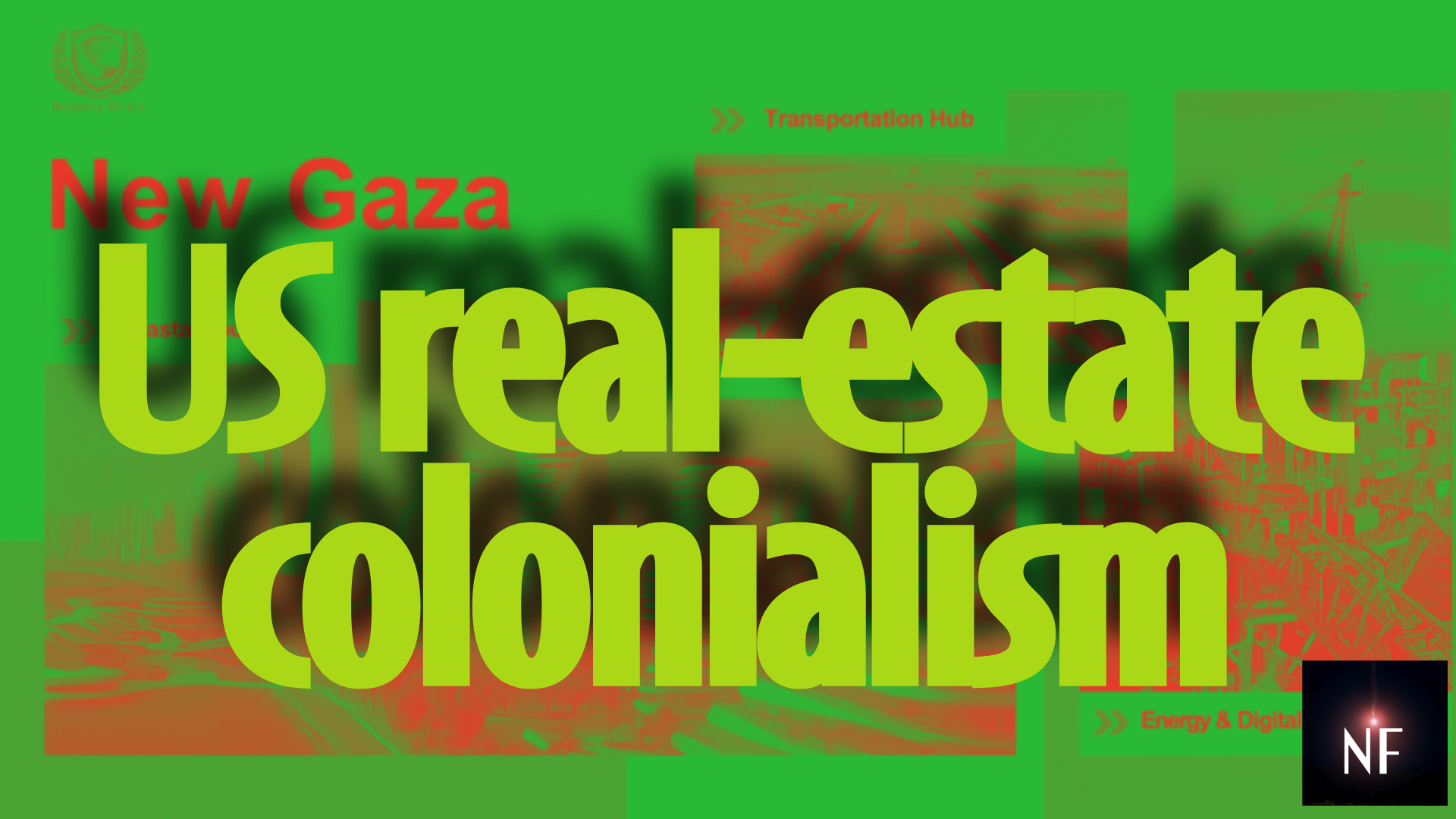
As US President Donald Trump presides over his “Board of Peace” to rule over Palestine’s Gaza Strip, American businesses are flocking to cash in on lucrative contracts for this colonial venture, including the notorious company running the so-called “Alligator Alcatraz” in Florida, a U.S. migrant concentration camp.
As often happens, the Trump administration’s “Master Plan” for Trump’s white-ruled Gaza Riviera echoes US settler colonization’s core driver (aside from supremacist ideologies): business.
The United Nations estimates that the reconstruction of Gaza will cost about $70 billion, which could be quite a lucrative windfall for companies. The world watched as the Gaza Humanitarian Foundation (GHF), a private American evangelical-owned company infused with $35 million by the US and possibly more from Israel, unleashed terror and death upon starving and emaciated Palestinian aid seekers, suffering under Israel’s total blockade. Now they face further genocidal ethnic cleansing and Western powers descending upon their lands to colonize.
In February 2024, four months into Israel’s genocide, Trump’s son-in-law Jared Kushner was already eyeing Gaza as future real estate to exploit, musing, “Gaza’s waterfront property could be very valuable.” The “Master Plan” was developed by Kushner, who reportedly commissioned the London-based Tony Blair Institute to draft plans for reconstruction and colonizing the Gaza Strip.
His counterpart and now U.S. special envoy, Steve Witkoff, is a real estate developer who, along with Kushner, negotiates with Israel on behalf of America, including in ceasefire talks.
While dozens of companies will place bids for Gaza reconstruction contracts, the Trump team is conducting business while preemptively laying claim to the Gaza Strip—a hallmark of European settler regimes, originating in 15th century Papal Bulls and the so-called Doctrine of Discovery.
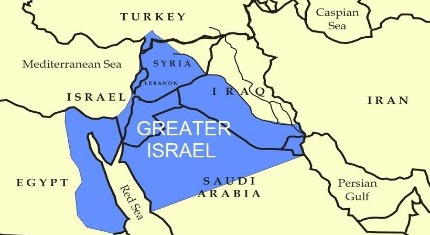
Emerging in the Christian Reformationist (now evangelical) reading of the Bible, land from the Egyptian Nile to the Euphrates River was given to the Jews by God, His “chosen” people. This colonial project would expand Israel’s “biblical borders” into at most seven countries: Lebanon, Syria, Jordan, Saudi Arabia, Egypt, Iraq, and Turkey. “It would be fine if they took it all,” said Mike Huckabee, US ambassador to Israel, to Tucker Carlson in Tel Aviv. That is “essentially the entire Middle East,” observed Carlson.
For Indigenous peoples, like Indian Tribes, this colonial circumstance is all too familiar. Settler colonialism is not just about the replacement of Natives with white settlers, but about land speculation and ownership, resource extraction, and a full spectrum of business exploitation. In Palestine’s case, America and Israel covet the land, its “rare earth minerals,” and the development of vast housing projects.
“The coastline alone is $50 billion of value on a conservative basis,” said Marc Rowan, CEO of asset management company Apollo Global, during the inaugural meeting of Trump’s Board of Peace. “It just needs to be unlocked and financed.”
Big business for racial empires
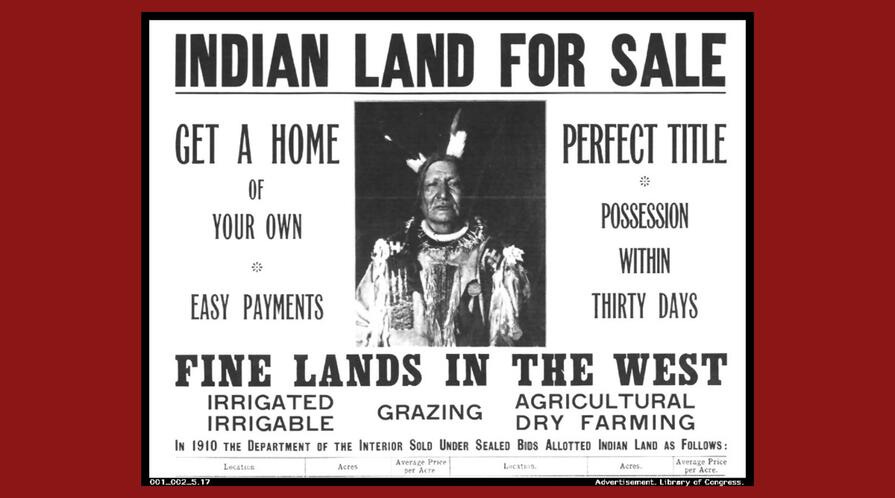
When the Homestead Act of 1862 was signed into law, opening up tens of millions of acres of Indian lands for sale and white settlement, the promise of land speculation and ownership in America had international appeal, particularly in Germany1.
America was awash in land lust for purchasing Indian lands. From individual settlers who wanted homesteads to corporate land speculators who wanted millions of acres at once to flip for resale, America truly experienced “land mania.” Others were traders, who developed trade networks with both settler townships and Indigenous nations. Yet to establish any legal basis for transferring Indian lands to US property, they needed to enter into treaty negotiations.
In order to gain leverage over tribes in treaty negotiations, the US used a familiar economic weapon: settler trade networks built Indigenous “dependence on trade goods” and trapped tribes in crippling debt. This dependence was exacerbated by settler overhunting, genocide, and disease, which decimated tribal populations. Many tribes were “reduced to a very small number” and were “virtually powerless” during treaty negotiations and were strongarmed to cede vast expanses of their homelands.
For example, a group of tribes known collectively as the Kaskaskia were ceded their lands, roughly one-third the size of present-day Illinois, after a massive population collapse and trade debt.
In a telling letter to future president and then territorial governor William Henry Harrison, Founding Father Thomas Jefferson described this debt-leverage treaty-making scheme.
“To promote this disposition to exchange lands which they have to spare and we want…we shall push our trading houses, and be glad to see the good and influential individuals among them run in debt, because we observe that when these debts get beyond what the individuals can pay, they become willing to lop them off by cession of lands,” wrote Jefferson in February 1803.
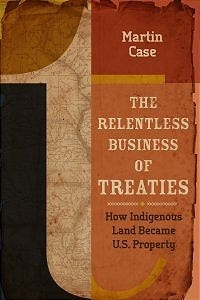
In his groundbreaking book “The Relentless Business of Treaties: How Indigenous Land became U.S. Property,” historian Martin Case spent a decade producing an exhaustive analysis of the Euro-American treaty signers who negotiated land cession terms with Indian tribes, and created the US property system. This work expanded into the Treaty Signers Project, sponsored by the peerless Indian Land Tenure Foundation (ILTF), a Native land recovery organization based in Minnesota.
The American treaty signers and negotiators weren’t just diplomats for the US government—most signers had vested political, familial, or financial interests in expanding America’s frontier borders into “Indian Country”—sound familiar? Of the over 2,300 men (no women) who represented the United States between 1778 and 1871, Case found biographical information on about 1,300 of the treaty signers.
After the Supreme Court decision in Johnson v. McIntosh in 1823, the court decided that the “exclusive title” to land could only be claimed by European states that “discovered” Native lands. At the time, the court decided “Indian inhabitants are to be considered merely as occupants” and that they are “incapable of transferring absolute title.” This decision would lay the foundation for, as Case writes, the treaty signers to instigate “a corporate takeover of 170 million acres and of the government that would control it.”2
(For more, I wrote a feature for Sierra, “The Land Back Movement unravels Manifest Destiny,” on ILTF’s work in 20233.)
Corporate interests are rife within treaty negotiations with Indigenous peoples, even today, especially when it comes to real estate and familial ties.
The ceasefire negotiations between the Zionist regime and Hamas were largely futile, but not for lack of tireless effort by Palestinian negotiators. The only leverage Hamas had was hundreds of Israeli hostages taken on Oct. 7, 2023, but as the Zionist regime bombed the Gaza Strip into the moonscape we see today, “Israel” had no interest in saving their citizens’ lives, nor making any deals such as leaving the Gaza Strip to save them. Instead, the bloodthirsty Zionists wanted land, and Oct. 7 was the ultimate excuse to conquer more Indigenous lands.
The ceasefire treaty negotiators included Trump’s son-in-law Jared Kushner and his business partner Steve Witkoff, both corporate millionaires dealing in real estate, pushed for disarmament of the Hamas resistance movement and relinquishing Palestinian land rights to the Gaza Strip, sealing a “legal” ethnic cleansing.
The colonial echoes of businessmen Kushner and Witkoff, and of other colonial figures participating in treaty negotiations, are common throughout history. All wanted a piece of Indian lands.
Indian treaty negotiations included individual settlers, owners of mining, timber, or trading companies, politicians climbing the political colonial ladders in occupied US territories, soldiers, frontiersmen, or militiamen, or even founding fathers like President George Washington, who signed several Indian treaties.
“Upon examination, these [signers] were not distinct subsets: military officers were land speculators, bureaucrats were business owners, settlers were militia officers,” wrote historian and author Martin Case. “And often enough to defy any expectations, these men were related to one another through family ties.”
On behalf of the US government, these men shaped and established the US property system and land ownership as it exists today, extinguishing “aboriginal title” to lands from Indigenous tribes and transferring hundreds of millions of acres into the American white-ruled settler regime.
As tribes began to lose their homelands, they began to be marched to military-enforced Indian reservations, almost always arid, possibly uninhabitable, and on lands considered “worthless” by settlers, leaving tribes with little ability to cultivate, subsistence hunt, or perform their ceremonies at sacred sites on their ancestral territories.
Meanwhile, the thousands of Euro-American treaty signers, whose lust for land, gold, and silver mining, and power continued to fuel America’s colonial “expansion” westward.
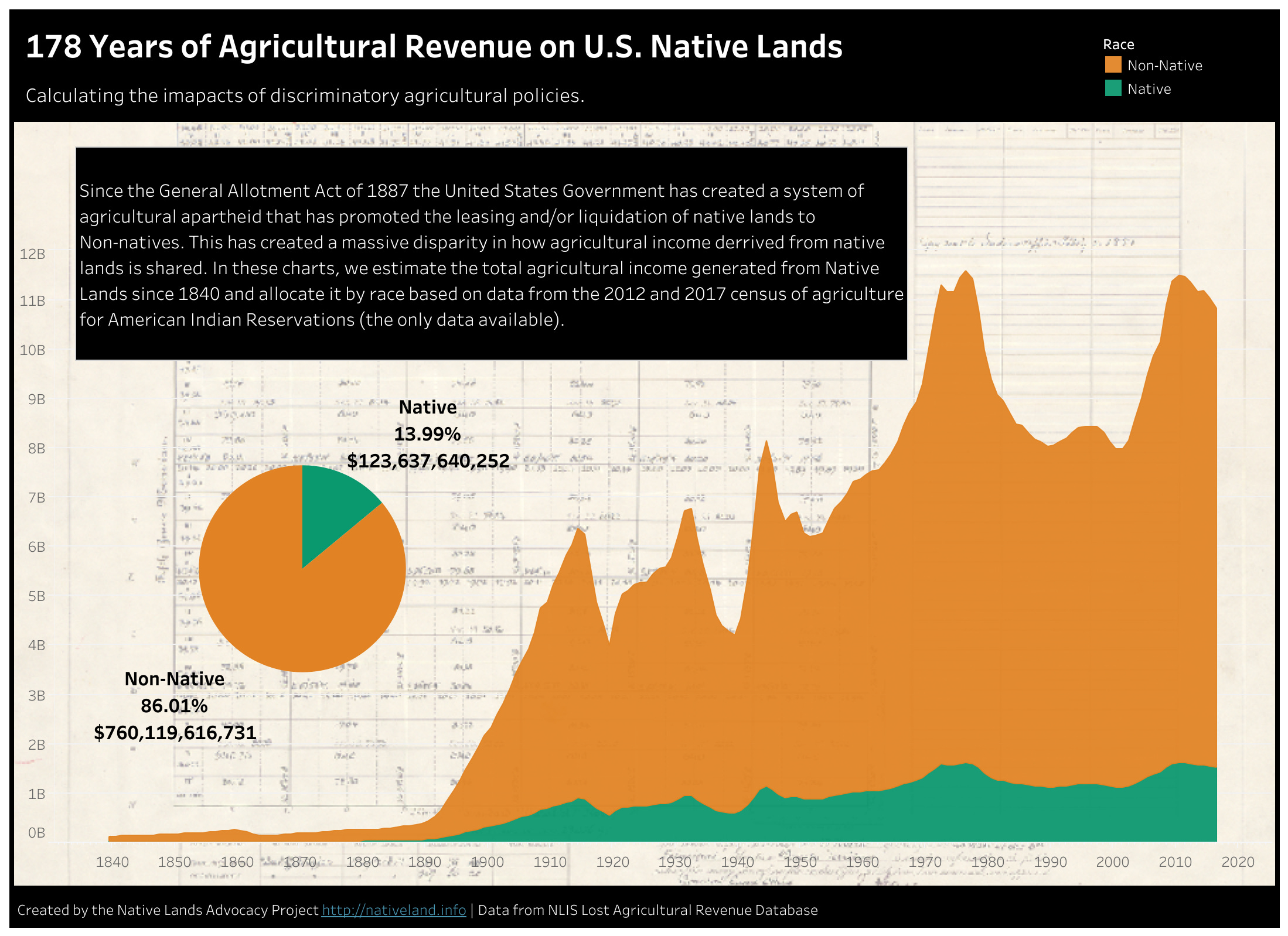
After the Homestead Act, the Dawes Act of 1887 was the next major land-grab legislation to extinguish Indian land and transfer about 90 million acres to American ownership.
Over 178 years since the signing of the Dawes Act of 1887, the Native Land Information Systems (NLIS) calculated that white settlers reaped over $760.1 trillion from Native lands, while Native revenue totaled over $123.6 trillion. Remember, these are lands ostensibly under Native jurisdiction after they are confined to Indian reservations, not their full ancestral lands across the continent that are either in private, state, or federal ownership.
This study offers invaluable insight into the economic legacies of land loss, yet it still only offers a glimpse of the transformation of America's industrial natural resource extraction, generational wealth, corporate supremacy, and political and state power over time. The US is still a global hegemony, and it achieved worldwide influence first through continental colonization.
Business and treaty negotiations go hand-in-hand. These negotiators scheme to profit while securing white rule on Native lands. [END*]
Robert L. Nelson, “The Frontiers of Empire: Max Sering, Inner Colonization, and the German East, 1871-1945,” published 2024. Page 39. [Free PDF on Oxford’s website].
Martin Case, “The Relentless Business of Treaties: How Indigenous Lands became US Property,” published in 2018. Page 18.
Funny enough, someone is selling a hard copy of this Sierra issue on eBay with my name in the listing.
100% on point, with the Jefferson quote about indebtedness (the same approach the US used to create "Third World Debt" back in the 60s), and Johnson v M'Intosh, etc. George Washington was a land speculator masquerading as a president.