

To stop history from repeating, tribes help their "uncontacted relatives" survive colonialism
Survival International's new report finds at least 196 uncontacted Indigenous groups living in 10 countries, and half of them will face annihilation if nothing is done.

Before you read, take this survey!
These are some ideas I’ve spitballed to see if you are interested in paid subscription posts from No Frontiers.
Starting now, I am writing, reporting, and publishing more regularly—at least once a week—and would like to know what will convince you to become a paid subscriber to No Frontiers.
I am implementing a paywall for articles older than 1 week. For the time being, articles will remain accessible to free subscribers for a week after publication, but thereafter they will be behind a paywall.
Now, on to the story.
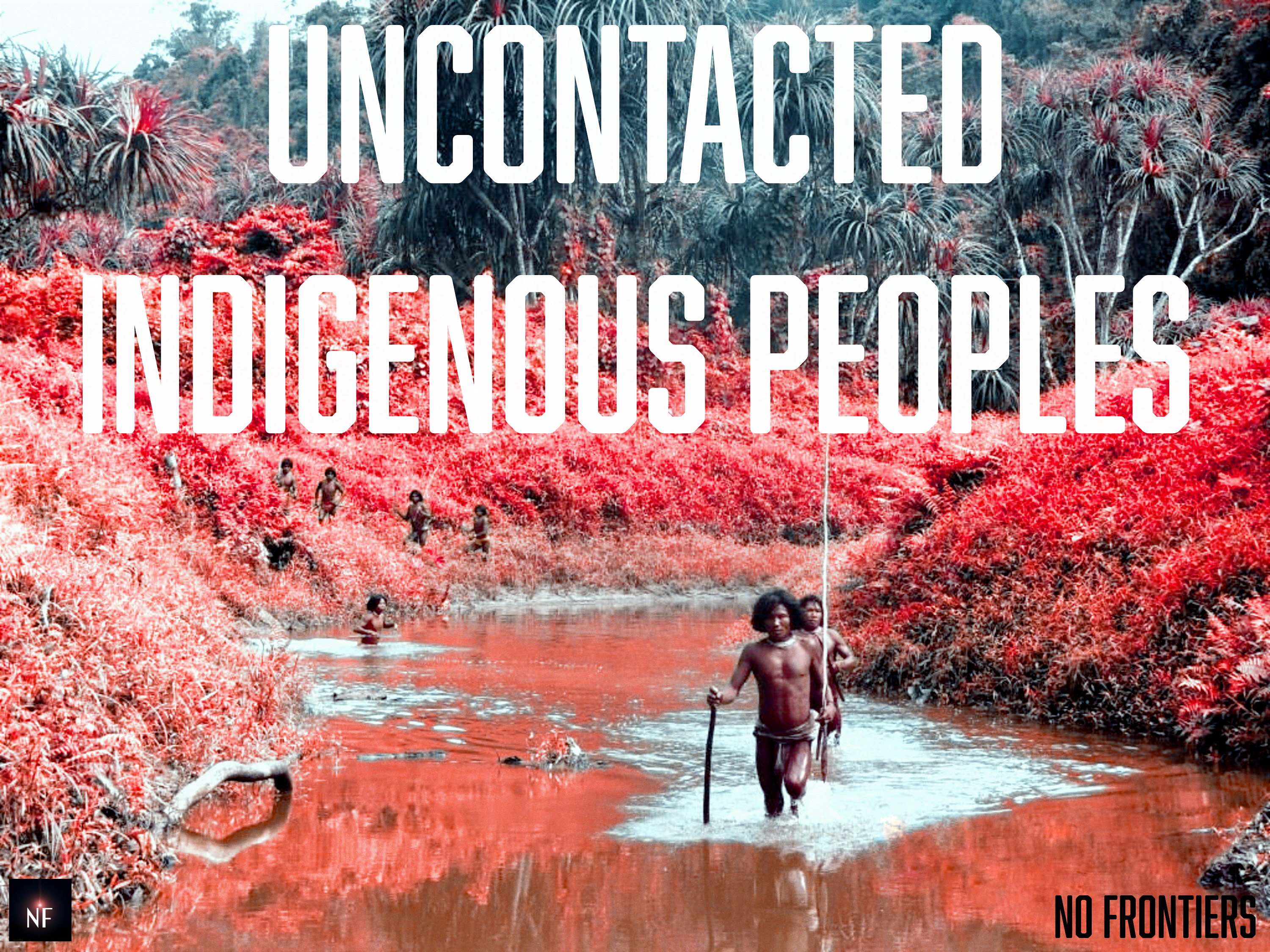
“Look, there are two worlds: There is the Indigenous world, and there is the non-Indigenous world of the white people,” recites Lucas Manchineri of the Manxineru people. “You,” he went on. “You don’t depend on anything. You’re living peacefully. However, if you come out of the non-contact situation, there are going to be all sorts of things that you’re going to need.”
These are the words Manchineri uses if he encounters an uncontacted Indigenous person, someone whose tribe wishes to remain separate from the outside, industrial, and largely Western-dominated world.
“You’re going to have the need for clothes, the need for money, the need for vehicles, transport—all this sort of thing,” he continued. “And what you have to understand is that in the world of the white people, you cannot live without money, and that’s a given. You can’t negotiate that.”
There are too few people like Lucas Artur Brasil Manchineri, an Indigenous land defender living in the Brazilian Amazon, and even fewer upholding his dire mission. Manchineri leads a team tasked with safeguarding a neighboring group of uncontacted Native people, known as the Mashco Piro people, that shares his people’s Indigenous territory. Illegal loggers and drug traffickers relentlessly invade the territory of his parentes desconfiados, or his uncontacted “Wary relatives” who are mistrustful of others, and violently threaten their homelands.
Most alarming are outsider’s ability to spread common diseases like the flu that aren’t especially harmful to us, but are deadly to uncontacted Indigenous groups. And they aren’t alone.
Nearly 200 uncontacted Indigenous groups, who choose total isolation from outsider societies, are under imminent existential threat. If nothing is done to protect them and their home territories, at least half will perish within 10 years, according to Survival International, an Indigenous human rights group that partners with local on-the-ground Indigenous organizations around the world.
“One of the reasons we’re doing this for our uncontacted relatives is so that history is not repeated,” Manchineri told No Frontiers, “because when we came into contact, our territory was invaded and everything, all the natural resources, a lot of them, were stolen, taken from us, and these people did not regard us as human beings.”
In the first-of-its-kind report, Survival International found that at least 196 uncontacted Indigenous groups face extermination from illegal incursions into their territories by resource extractive industries like mining or logging, drug trafficking gangs, evangelical missionaries spreading christianity, and even social media influencers seeking “first contact”—all of which risk the spread of deadly communicable diseases. These groups survived hundreds of years of European colonialism: settler invasions, genocide, enslavement, disease epidemics, land theft, and industrial infractions. Now they want to live in peace without outside contact.
As Native societies, whose history pre-dates European invasion, they wish to maintain their cultural, linguistic, group identity, which are distinct from outside industrialized societies that were forever altered by Western colonialism. It’s about choice, their right to self-determine their own future on their ancestral territories—uncontacted. But without protection or respect for their isolation, the risk of annihilation by illegal land invaders is too great.
Whole Indigenous groups, contacted and uncontacted, have succumbed after forced contact with outsiders. And the stakes are inceasing as rivers and streams shrink or dry up, because of climate change, and illegal loggers or miners infiltrate throughout the rainforest to clear land for cattle ranching, or drug trafficker gangs encounter them.
“When we were first contacted, sometime ago,” said Manchineri, “we had nobody to defend us. That’s why we are defending out uncontacted, wary relatives, because we know what it’s like.”
Threats from all sides
Lucas Manchineri lives in southwestern Brazil, near the intersection of Brazil, Peru, and Bolivia—what he calls the “triple frontier.” As president of Manxinerune Ptohi Phunputuru Poktshi Hajene, or MAPPHA, his job’s mandate is twofold: protect his Indigenous territory and the Mashco Piro people, who share the same land in the dense Amazonian forest and wish to remain undisturbed.
To keep them safe, Manchineri’s team at MAPPHA go on monitoring excursions into the rainforest, collecting GPS data, marking points where their uncontacted relatives are frequenting, paths they travel, all to serve as evidence to present to international advocacy groups. At the same time, his team also monitors and maps the movements of illegal agribusiness land invaders, drug runners, cattle ranchers, loggers, and miners—all of whom are often armed.
“Whenever we go on a trip or expedition or an operation, we’re always prepared to receive them [the uncontacted], just in case they make contact or an unexpected contact happens,” Manchineri told No Frontiers. “So we are vaccinated, all the people who've gone on the expedition have to be healthy, but more than that, the government needs to ensure that in all the territories where there are uncontacted, there is a health post in operation and medical teams on standby in case there are contacts.”
If an uncontacted tribe comes close or engages with Manchineri and his team, they explain the situation to them, the dangers of outside contact like disease transmission, but also how different industrial society is to theirs.
It’s difficult to overstate how vulnerable uncontacted tribes are to otherwise common diseases like the flu, measles, or diarrhea, which can exterminate them in a matter of days. In the 1980s, the Brazilian dictatorship’s policy of contacting previously uncontacted tribes was disastrous beyond measure. “If an uncontacted person comes into contact and gets flu and they go to their maloca, the big communal house, everyone in that maloca will catch the flu,” said Manchineri. “It will be transmitted to everyone, and 90% of them will be exterminated just by something small like the simple flu, and it’s our fault.”
Today, Brazil has laws supposedly guarenteeing the rights of uncontacted and contacted Indigenous peoples, and FUNAI (Brazil’s Indian Affairs Department), a government agency charged with safeguarding their rights. While this is an improvement, the government has little power and resources to enforce these laws, while many local to national politicians looking to get rich from agribusiness, like cattle ranching, are eyeing their ancestral lands.
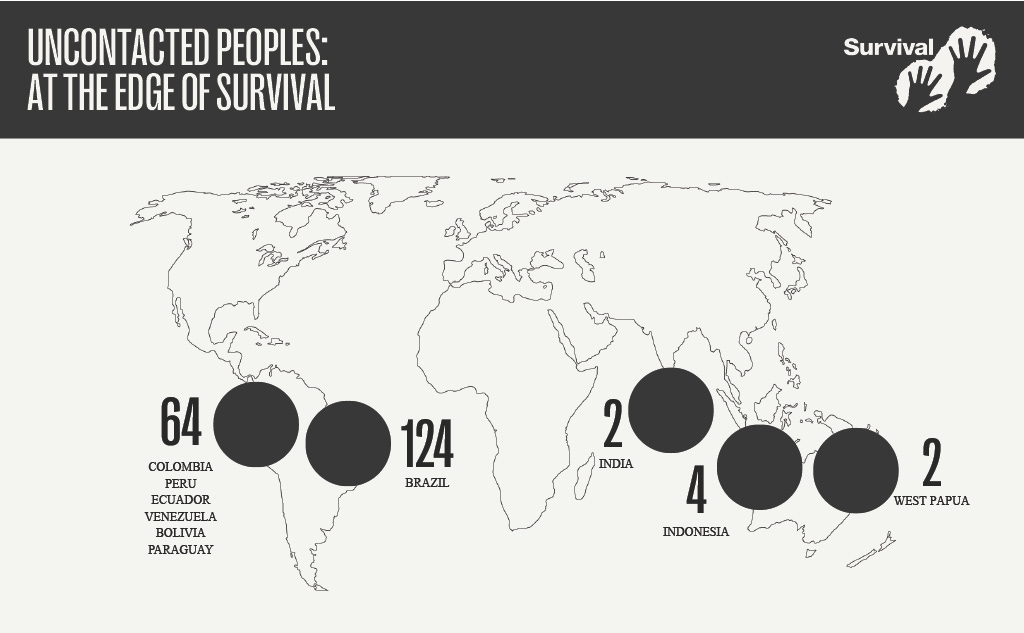
Uncontacted Indigenous groups live across 10 countries in South America, Asia, and Pacific: Colombia, Peru, Ecuador, Venezuela, Bolivia, Paraguay, Brazil, India, Indonesia, and West Papua. By far, the most live in South America, with 124 uncontacted groups—a vast majority—residing in the Brazilian Amazon rainforest. Another 64 uncontacted groups live across six neighboring countries.
“That’s one of our big campaigns at the moment, is for the rights of the uncontacted peoples to determine their own futures, to be uncontacted,” said Fiona Watson, director of research and advocacy at Survival International, who’s worked for Survival for over 35 years. Headquartered in London, England, Survival International has been the only human rights organization campaigning worldwide to protecting the Indigneous right to remain uncontacted.
The work at MAPPHA is never ending, and needs continuous financial support, like many Indigneous organizations. They need to buy canoes, boats, gasoline, and more to monitor the forest.
“The government machinery works extremely slowly, and because it’s so slow, in the meantime, things just keep deteriorating,” said Machineri. “And I’m speaking to you, one Indigneous person to another. I think that you will understand what I mean by this message.”
“Hidden genocides”
Fiona Watson saw firsthand how lonely life can be for Native uncontacted individuals, realing from underreported “hidden genocides” by violent invaders. During the mid-1990s, cattle ranchers began bulldozing the forest, clearing trees and communal houses built by the uncontacted Akuntsu people. Then the ranchers hired gunmen to massacre the Akuntsu, and claimed there were no Indigenous peoples residing on the land.
When outsiders made contact with the Akuntsu people in 1995, there were seven tribal members. After the massacre, it took about a decade and observations by a neighboring tribe, the Kanoê people, to find signs of any Akuntsu survivors and piece together what happened.
“The Kanoê eventually did make contact with them, but everything took a long time for the story to come out, and nobody has been tried for the killings,” said Watson. “People have a good idea of who was behind it, the intellectual authors, but it happened so long ago.”
Around 2005, the Kanoê people reported to FUNAI and Survival International of finding signs of a sole Akuntsu survivor, living a lonely, solitary life on his own in the Brazilian Amazon. He left behind traps, broken pottery, arrowheads, calabaches for storing water, nuts, and a garden of paw paw, manioc and corn. At the time, no one knew his name, the name of his tribe, or what language he spoke. They simply called him the “Last of his Tribe.”
It’s now known this man wasn’t completely alone, and had two other surviving companions from his tribe. They are still alive to this day. Yet, with only three Akuntsu people left, Survival International says, “Their genocide will likely soon be complete.”
Around 2000, Survival International estimated there were 70 uncontacted peoples worldwide. But after decades of research, Survival found there are at least 196 groups, based upon the most detailed and up-to-date survey of uncontacted groups.
Over 96% of uncontacted groups are imperiled by extractive industries, with logging as the most persistent threat, endangering 65% of groups, and often precedes more land exploitation, and is followed by mining, which threatens over 40% of uncontacted groups. About one-third face threats from criminal gangs, while one in six uncontacted peoples are threatened by missionaries attempting to convert them.
Unfortunately, several missionary groups are often just as hellbent on contacting remote Indigenous peoples as industries are for stealing their lands. The moneyed US-based Ethnos360 (formerly New Tribes Mission) is an evangelical Christian group expressly devoted to contacting and converting isolated Indigenous tribes.
In the 1980s, New Tribes Mission invaded the lands of the Zo’é people of northern Brazil, building a base and airstrip on their land to force contact—all without the knowledge of the Brazilian government, which had recently instituted its “no contact” policy for these groups.
By 1988, flu and malaria epidemics brought by New Tribes Mission raged through the community, killing about a quarter of the Zo’é people. The missionaries were kicked out of the country, but the Christian group continued to force contact. The Zo’é people aren’t the only uncontacted groups New Tribes Mission had devestated.
“There’s very heart rending testimonies about the Ayoreo [Totobiegosode] peoples in Paraguay of what the New Tribes Mission did to destroy tese people in the seventies and eighties,” said Watson. The New Tribes Mission organized “manhunts” to kidnap Ayoreo and convert them by forcing them to renounce their cultural and religious beliefs, and way of life.
To these missionaries, Watson explains, Indigenous lives don’t matter. “What matters is you make the contact, because you have to bring the Word of God to these people,” said Watson. “You have to convert them, and in the process, if they get diseases and die, it doesn’t appear to matter very much to them, because what it is is about saving, in their view, saving souls.”
The danger of evangelical missionaries, says Watson, is that they are fundamentalist. They can’t be reasoned with.
“No contact policy”
Survival International promotes a strict “no contact policy,” both within their organization and their campaigns, so they learn about the uncontacted groups from partnering with the contacted neighboring Indigneous groups, who are determined to protect their isolated relatives.
“What we most commonly hear is that these people are under threat and that they’re really facing a lot of dangers, but that when their territory is protected, they thrive,” said Callum Russell, Asia and Pacific researcher and advocacy officer for Survival International. “And the contacted Indigneous peoples remember what life was like before they had contact, and some of them tell us, you know, life in the forest was great.”
They say, “We wish this has never happened to us in the first place,” explained Russell. “So they are determined to stop that happening to their uncontacted neighbors.”
On the other side of the world, two uncontacted groups live in India, four groups live in Indonesia, and two more live in West Papua (but potentially up to 10 groups). Indigenous groups sharing land with uncontacted relatives are begining to advocate on their behalf, looking after them by leaving gardens in the forest to feed them. Many are lobbying their national governments to enforce their protection. In Indonesia, at least 19 nickel mining concessions overlap the territory of the uncontacted, spread across tens of thousands of hectares—home to the largest nickel mine in the world owned by Paris-based company Eramet.
“They are really threatened by that now, and the uncontacted are coming out of their forest and aiming arrows at the bulldozers,” said Russell.
Get too close, one may recieve an arrow shot overhead in warning, or even attacked. They will do what is necessary to defend their tribe from outsiders. In 2018, an American evangelical missionary traveled to India to make contact and convert the Sintinelese people and was killed. It’s illegal to even approach within five miles of the tribe’s island.
Before he died, the missionary wrote in his diary, “Lord, is this island Satan’s last stronghold where none have heard or even had the chance to hear your name?”
For those paying attention, these uncontacted groups want to be left alone. “And it’s very clear that’s what they want, and we can tell that all sorts of signs, of leaving crossed arrows or spears on their hunting trails, or firing arrows like that very iconic photo you might have seen of the Sentinelese man shooting at the Indian Coast Guard helicopter when they flew over to see if they’d survive the tsunami,” said Fiona Watson.
After decades of campaigning by local organizations and Survival International, the Indian government abandoned all attempts to contact the Sentinelese on their unique remote island. On paper, Russell says, India’s policy is to protect the Sentinelese and the uncontacted Shompen people, but recently the national government began to covet the Great Nicobar island for massive industrial development “on a terrifying scale” with plans to cut down millions of trees.
The contacted Nicobarese people of Great Nicobar, India are speaking out for the Shompen people, their hunter and gatherer uncontacted relatives in the forest, who are being threatened by a mega-infraestructure project by the Modi government aimed at transforming their small island into the so-called “Hong Kong of India.”
“The only way they will survive is for this project to be cancelled,” said Russell.
Often, Indigenous groups will plant vegetable gardens for the uncontacted, whose forests are being logged. They also recognize where isolated groups hunt or travel, so they keep their distance, give them space undisturbed, and safe from potentially contracting any outside illness. These Indigenous groups are on the front lines, protecting the lands for all Native peoples.
If the “Hong Kong of India” is realized, there will be hundreds of thousands of permanent settlers on the small island. The mega project’s own environmental impact statement basically admits the development and environmental destruction would have a high chance of wiping out the Shompen people.
Colonialism continues. It never ended. For the uncontacted, especially, this means resistance to colonialism continues. “They are often traumatized by what their ancestors experienced, by what neighboring Indigenous peoples experienced,” said Russell. “They’re traumatized because they see their forests being destroyed, because they feel the pollution in the water and quite possibly in the atmosphere.”
For many Indigenous peoples, forced contact was the most devastating moment in their tribal history. But that doesn’t have to persist.
“I want to say to all the people and peoples out there in the world is for you to put great value to the Amazon rainforest where the original peoples [live]—that is, the elders, the Wary People, the uncontacted people—to really appreciate and value them, because they have never had any contact and they really demand and deserve our respect,” said Manchineri.
“Don’t steal from them. Don’t invade their lands. Don’t take diseases to them. Respect and value these peoples, and also my people, the Manxineru people, because we live and share the same land.” [Fin]
Read the report and more
Download the groundbreaking report “Uncontacted Indigenous Peoples: At the edge of survival,” a global investigation into the survival of uncontacted peoples, and visit Survival International’s uncontacted groups campaign site uncontactedpeoples.org.
Learn more about the Indigenous right to self-determination, a right rooted in global decolonial struggles in the 1970s, and now recognized internationally by groups like the Inter-American Commission on Human Rights (IACHR), as well as the right to Free, Prior and Informed Consent, a foundational Indigenous treaty norm.
And finally, read more about uncontacted peoples around the world, like the uncontacted Awá in the northern Brazilian Amazon who constantly flee from non-Indigenous invaders; how forced contact on the Nukak people in Colombia led to mass deaths from disease; and how nickel mining companies invade uncontacted Indigenous territories in Indonesia.
https://muse.jhu.edu/book/26080
"Cultural Forests of the Amazon: A Historical Ecology of People and Their Landscapes" William Balee
2013
Great piece. One critique; when blaming white people as a whole it slams the door.
I am Metis but look white and basically raised ‘white’.
Fact is white people are indigenous people that have had their land, autonomy etc. usurped further back. Also, they have been used and abused as pawns and canonfodder (under coercion, deception, false promises, threat of violence and inflated expectations) by the POS predator class.
This predator class only wins when the insult whiteness is used. Division amongst all those under these totalitarian psychopaths is their best tool.
Yes there are definitely white people that have been fooled into being racist fucks. This needs to change. The bigger problem of the predator class being solved would do much to knock racism into the grave it needs be in.